

Wholesale TPU Car Wrap: The Technical Guide to Manufacturing
The automotive customization industry is currently undergoing a massive technological transition. For years, the market was dominated by traditional PVC vinyl wraps, but today, a new player has taken the throne: the Wholesale TPU Car Wrap. This shift isn’t just about aesthetics; it’s about a fundamental upgrade in material science that combines the vibrant aesthetics of a color change film with the legendary protection of Paint Protection Film (PPF).
For business owners in the automotive sector, understanding the “how” behind the product is the key to choosing a Premium TPU Vinyl Wrap Supplier. Not all TPU films are created equal, and the manufacturing process dictates everything from installation ease to long-term durability. In this guide, we will pull back the curtain on the five primary production technologies used in the industry today and explain why professional detailers are moving away from PVC toward high-performance TPU solutions.
Why the Market is Shifting to TPU Color Change Film
Historically, if a customer wanted to change their vehicle’s color, they used PVC vinyl. If they wanted protection, they used clear TPU PPF. However, PVC is inherently limited; it is prone to fading, lacks self-healing properties, and often becomes brittle after only two years of UV exposure.
The introduction of Self-Healing Color Change Film made of Thermoplastic Polyurethane (TPU) solved these pain points. By utilizing a material that is naturally elastic and chemically stable, manufacturers can now offer a TPU Wrap For Professional Detailers that lasts twice as long as vinyl while providing genuine rock-chip protection. As a distributor, sourcing High Quality TPU Color Change Film For Car Wrapping Businesses is no longer a luxury—it is a competitive necessity.
Decoding the 5 Main TPU Manufacturing Processes
To the untrained eye, two rolls of colored film might look identical. However, the internal structure determines whether the film will fail in six months or last for five years. Here is a technical breakdown of the current industry standards.
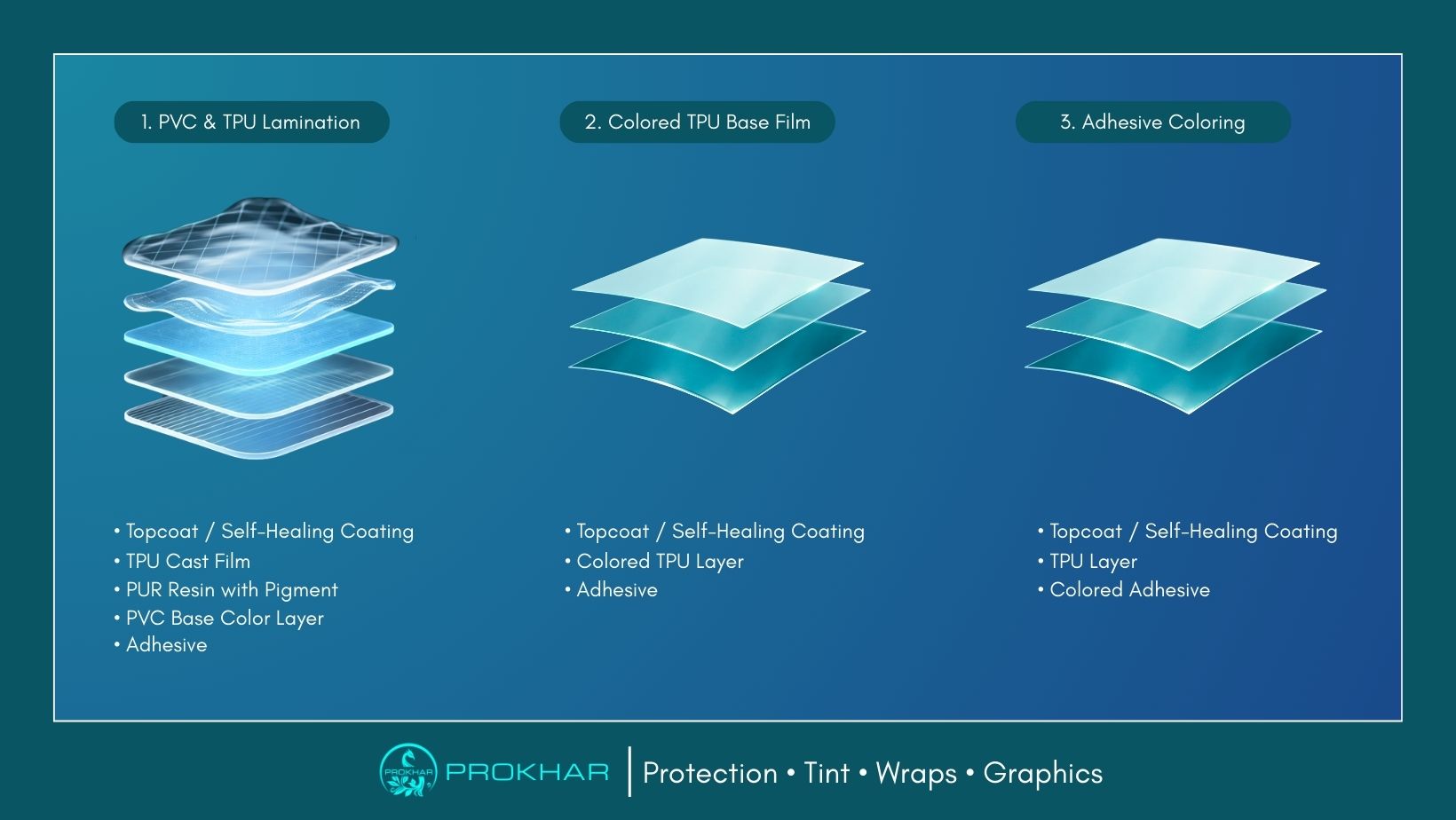
1. PVC & TPU Lamination (The Hybrid Approach)
This process involves casting a thin TPU film over a colored PVC base layer, followed by a self-healing top coat.
- The Logic: It attempts to use the color variety of PVC with the surface feel of TPU.
- The Reality: While the initial gloss is high, this hybrid structure suffers from poor weather resistance. Because the layers have different expansion rates, the film is prone to deformation and lacks the full elasticity required for complex curves. For a Premium TPU Vinyl Wrap Supplier, this is often considered an entry-level “budget” product.
2. Pigmented Surface Coating
In this method, a colored liquid resin is coated onto the underside of a transparent TPU base.
- The Logic: It is easy to mass-produce and offers incredibly vibrant, “popping” colors.
- The Reality: The bond between the color coating and the TPU base can be weak. Over time, particularly in high-heat environments, the film may experience “edge shrinkage” or delamination. While visually stunning, the structural integrity is lower than fused methods.
3. Pigmented Adhesive Technology
This is perhaps the most cost-effective way to produce a Wholesale TPU Car Wrap. Instead of coloring the film, the pigment is mixed directly into the adhesive layer.
- The Logic: Simplifying the production steps to lower the TPU Car Wrap Price.
- The Reality: This is the most “risky” option for professional shops. Adding pigments to the adhesive changes its chemical composition, often leading to reduced bonding strength and “ghosting” or adhesive residue upon removal. Detailers usually avoid this for luxury projects due to the lack of stability.
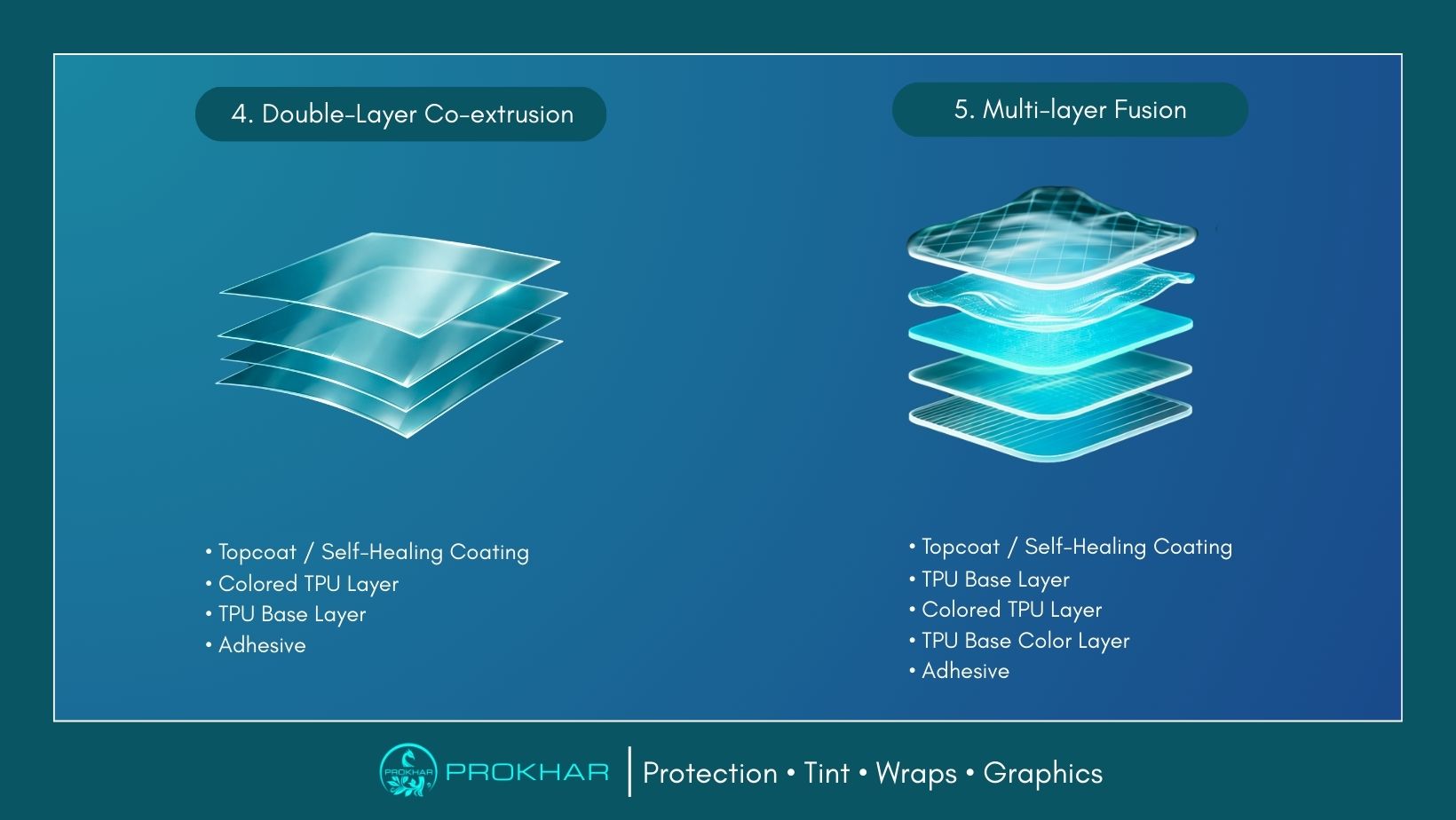
4. Double-Die Co-Extrusion
This is where we move into premium territory. Using a double-die extrusion system, the colored TPU layer and the base TPU layer are extruded simultaneously.
- The Logic: The two layers are fused at a molecular level while still in a molten state.
- The Reality: This creates an incredibly stable and durable film. There is zero risk of delamination, and the physical protection properties are maximized. The only limitation is the high cost of machinery and the difficulty in switching colors quickly, which is why it is usually reserved for high-volume, flagship colors.
5. Multi-Layer Fusion (The Gold Standard)
Currently the most advanced technology available, the Multi-Layer Fusion process creates a sophisticated 5-layer structure: a self-healing top coat, a transparent TPU shield, a primary TPU color layer, a secondary TPU base color layer, and the adhesive system.
- The Logic: The transparent TPU layer protects the color from oxidation, while the dual color layers provide deep, “paint-like” saturation.
- The Reality: This is the High Quality TPU Color Change Film For Car Wrapping Businesses that mimics original factory paint. It offers the best balance of flexibility, color depth, and durability. This is why PROKHAR focuses on this specific technology for our premium lines.
Why Detailing Pros Prefer PROKHAR TPU Color Wraps
In the B2B world, a “comeback” is a profit-killer. If a film fails, the detailer loses time, labor, and reputation. This is Why Detailing Pros Prefer PROKHAR TPU Color Wraps. We don’t cut corners with pigmented adhesives or low-grade laminations.
By focusing exclusively on Double-Die Co-Extrusion and Multi-Layer Fusion, PROKHAR ensures that every roll of Wholesale TPU Car Wrap we ship meets a “Zero-Defect” standard. Our films are engineered to provide:
- Superior Stretch: TPU’s natural 300%+ elongation allows for seamless one-piece installations on bumpers and mirrors.
- Deep Gloss & Clarity: Our multi-layer tech eliminates the “orange peel” texture common in PVC wraps.
- A 5-Year Promise: We provide a Wholesale TPU Color Change Film With Five Year Warranty, covering everything from fading to cracking.
ROI of TPU vs. PVC
For a car wrapping business, the math is simple. While the initial cost of a Wholesale TPU Car Wrap is higher than vinyl, the value proposition to the end-consumer is exponentially better.
- Lower Labor Costs: Because TPU is more conformable and features advanced air-release technology, installers can finish jobs faster and with fewer errors.
- Higher Ticket Prices: You aren’t just selling a color; you are selling a “Self-Healing Shield.” Customers are willing to pay a premium for a product that heals itself from swirl marks under the sun.
- Customer Retention: A car that looks perfect five years later is the best marketing tool for any detailing shop.
Partnering with a Premium TPU Vinyl Wrap Supplier
The era of choosing between “looks” and “protection” is over. The modern Self-Healing Color Change Film offers both in a single, high-tech package. As the global market for Wholesale TPU Car Wrap continues to expand, the winners will be the distributors and detailers who prioritize technical excellence over the lowest possible price.
At PROKHAR, we are committed to pushing the boundaries of what is possible in automotive film technology. By mastering the complexities of multi-layer fusion, we provide our partners with a product that is as reliable as it is beautiful.
Key Highlights for Our Partners:
- Stability: Fused layers prevent delamination in extreme climates.
- Efficiency: Advanced adhesive systems designed for the TPU Wrap For Professional Detailers.
- Reliability: Backed by a comprehensive 3-5 years international warranty.
Are you ready to transition your inventory to the next generation of wrap technology? Would you like a sample of our Multi-Layer Fusion series to compare the stretch and color depth against your current supplier? Contact PROKHAR today.

TPU Car Wrap Structure & Key Properties
Discover the technical structure of TPU car wrap. Learn why TPU wrap film is superior to PVC for car